Chandan Das Author
Biography not available.

Browse all FOLKLORE books
Browse all GARDENS books
Browse all GRAPHIC NOVELS books
Browse all HISTORY - MEDIEVAL books
Browse all HUMOUR books
Browse all Juvenile Fiction : Biographical - Other books
Browse all Juvenile Fiction : Historical - Other books
Browse all Juvenile Fiction : Legends, Myths, & Fables - Other books
Browse all Juvenile Fiction : People & Places - Other books
Browse all Juvenile Fiction : People & Places - United States - Other books
Browse all Juvenile Fiction : Religious - Other books
Browse all Juvenile Nonfiction : History - Other books
Browse all Juvenile Nonfiction : Mathematics - Advanced books
Browse all Juvenile Nonfiction : People & Places - Other books
Browse all Juvenile Nonfiction : People & Places - United States - Othe books
Browse all LITERARY STUDIES books
Browse all LONDON books
Browse all Medical : Nursing - Mental Health books
Browse all MIND books
Browse all MUSEOLOGY books
Browse all NON-CLASSIFIABLE books
Browse all NONLINEAR SCIENCE books
Browse all POPULAR SCIENCE books
Browse all RELIGIOUS STUDIES books
Browse all SPIRIT books
Browse all SPORT books
Browse all TRAVEL WRITING books
 Out of Stock
Hardback · ISBN 9798906961709
Inclusive of GST and other taxes
Arriving at your doorstep in 10-15 days
Our logisitcs team will make sure everyitem is delivered safely
| ISBN | 9798906961709 |
|---|---|
| Publisher | Notion Press |
| Publication date | September 2026 |
| Language | English |
| MRP | £22.99 GBP |
| Page count | 300 |
| Item weight | 157 g |
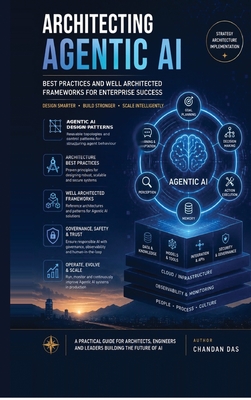
Most agentic systems do not fail because the model was not clever enough. They fail because a tool description was ambiguous enough to route the wrong way, because a loop had no defined way to stop, or because a credential was scoped to the agent instead of the task.These are not new problems. They are the classical problems of distributed systems, identity, authorisation and auditability, arriving in unfamiliar clothing and meeting teams who have been told the interesting part is the prompt.An agentic system is one in which a probabilistic component influences runtime control flow and real-world actions. That single property creates nearly every new architectural problem it faces, and the answer is not better prompting. It is placing authority outside the model: in deterministic validation, in policy the loop cannot reach, in ceilings it cannot raise, and in evidence written before an action, not after.Chandan Das offers a reference and an assurance instrument for the architects, platform leads and security teams who must put agents into production and defend the design afterwards. Eleven pillars. Thirty-seven numbered principles. A reference architecture, a pattern catalogue, a unified threat model, three worked designs, a maturity model, and a seventy-two-question architecture review.It is opinionated by intention. Where a choice is situational, it says so and names the deciding axis. Where the field has learned something expensively, it states the rule plainly.
Log in to write a review for this book.
No reviews yet. Be the first to share your opinion.
Biography not available.